Editorial | The Internet
Read Time: 15 min
This is a people problem.
Websites that operate like Bluesky have existed, arguably, since Usenet. If you want to get really particular, the trend began with PlanetAll of 1996, the first "social networking platform" on the internet. Bluesky, like PlanetAll, is a company trying to redefine what it means to use the internet on a fundamental level. Unlike PlanetAll, Bluesky is attempting to redefine the internet by presenting the public with a service that is fundamentally the same product as Twitter, only now it's owned by someone else.
There are people who genuinely belive in the AT Protocol and I am not one of them. I think that the structure can be recovered — salvaged, even — but Bluesky Social PBC is not going to be the company that sees it through to the end.
Deep-dive projects like Blacksky show that the actual core of the social media movement can be changed and maintained, but it needs to be a radical change. There is no way to get out of this without completely rebuilding these communities from the ground up, and Bluesky as a company is not interested in that process. It has rebuilt Twitter from scratch and recreated all of the problems with its design and more. To its average user, it is an infuriating failure.


According to their own company page, "Bluesky was initially a project kicked off by Jack Dorsey when he was CEO of Twitter in 2019... to build an open social protocol for public conversation that [Twitter] could someday become a client on." Those priorities lead to the formation of the Bluesky team as it currently exists in 2026: Trend-chasers who are trying to build the "framework of the future" for other companies to invest in.
It's a really poor fit for people who need to run one of the websites that the AT Protocol was designed to be a platform for. It's not good enough to just develop, code, market, and play around on the site — there needs to be a clear distinction between staff and users and moderators. The people who code the site cannot act like regular users with no stake in the operations of the company. The people who make moderation decisions cannot decide that some users of the site are less important than others because they share their own negative opinions. It's bad for optics.
This is an important thing to point out because at the end of the day the Bluesky team is highly opinionated and highly disorganized. The same people who "program" the website are also using that fact as leverage to hold key features over their user's heads like a carrot on a stick. Moderation decisions are invisible, but the reasoning behind those decisions becomes public knowledge as soon as a staff member starts vent-tweeting about it.
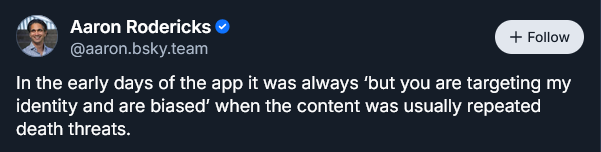
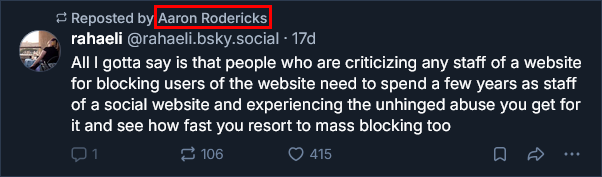
To make matters worse, Bluesky has a fundamental user problem. I don't mean that the users are bad, just that they're the kind of users that Bluesky Social PBC doesn't want.
Dan Olson of Folding Ideas makes this point perfectly in his video VidMe, or Why Platforms Aren't Your Friends:
"If you compete with a monolith, the first people to jump on board will be the people who were tossed off the other ship — and most of them were tossed off for a reason."
Looking at social media as a monolith, who are the people who were tossed off the ship?
Well... queer people, especially trans women, black people — who are disproportionately affected by poor moderation and content algorithms, furries, porn artists, and sex workers. Twitter is also notorious for being bad with engagement, and there was additional pressure from Tumblr's poor management for artists to get off of the site, so a majority of the people who used Bluesky as a lifeboat were also trying to make a living off of art.
The end result is that Bluesky immediately, permanently became a site that people used as an escape from Twitter — but as you know, Bluesky is Twitter. Even after Elon Musk bought out the site, the people who made Bluesky were fundamentally trying to be in conversation with that ecosystem. Bluesky wasn't a lifeboat, it was another sinking ship that gave everyone standing on it a good look at all of the other ships sinking around them.
That's the kind of ecosystem that makes your users get really weird.
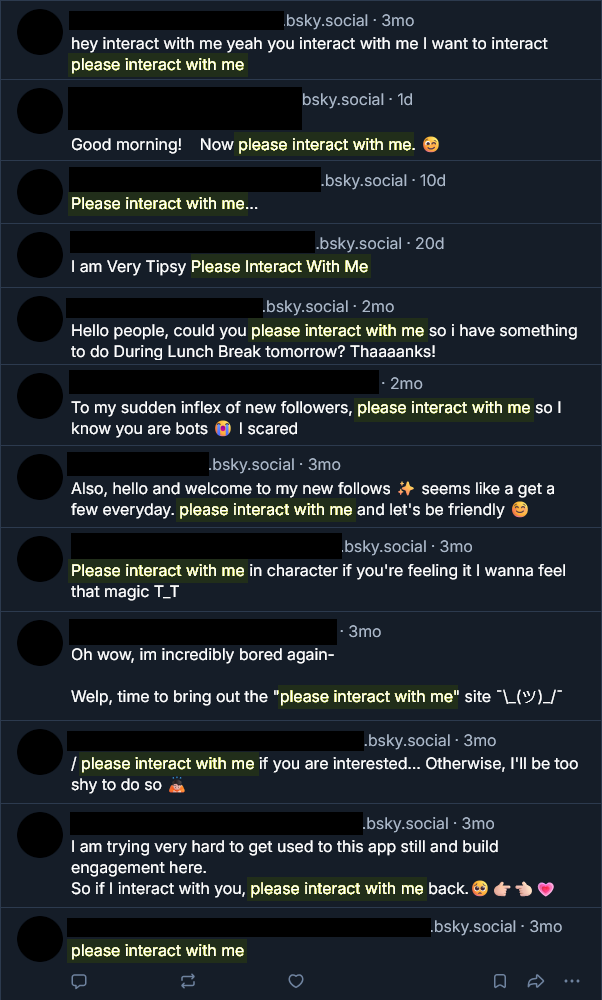
I'm going to cut to the chase.
Bluesky's fundamental problem is that it's a version of Twitter that made its userbase believe that it was an escape; a solution to the problem. When people migrated en-masse in September of 2024, they were met with an already established user base — mostly consisting of leftists, queer people, and perverts — that hated the fact that new people were flooding the site and ruining their sense of interaction with their other established users.
Over the course of 2025 it became clear that Bluesky, a company with roughly 30 employees, was not nearly prepared to handle that many new users and the number of complaints that they generated. Staff members started basically crashing out in their own replies, there were mass suspensions aimed at trans women and Palestinian users for seemingly no reason, and the responsibility for coding their multi-million user website was handed off to an AI.
This created a huge rift between the core userbase — who widely love trans women and hate LLMs — and the owners of the nice shiny website they were all stuck using. Artists had already made the jump from Twitter, so anyone who wants to look at pornography was trapped, and even then there were no good alternatives for a social media marketing platform. Bluesky's sinking ship became the only ship.
For anyone who wasn't satisfied, you could either put up with the site falling apart or you could stop using social media. Bluesky had become the Discord to Twitter's Skype, but it seemed like nobody actually wanted to be there. New users hate old users, conservatives hate leftists, politicians hate sex workers, and the site's staff hate fucking everybody.
Nobody has anywhere else to go. What do you do when you're trapped in a room with a bunch of people who will pick apart anything you say and use it to turn each other against you?
You stop talking.

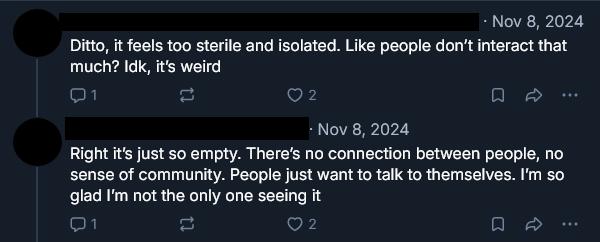
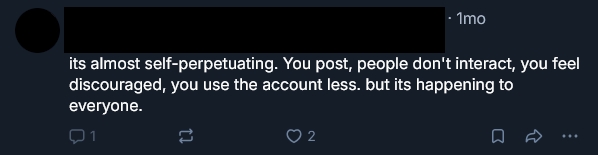

Bluesky isn't dying. I've called it a sinking ship, but it's not dead in the water; there's a lot of reasons to use the site, to stay on it.
Even so, after using the site for multiple years, and talking to other real life people about it... it's clear that the site is struggling to help users talk to one another.
Interaction is low. Replies are almost nonexistant, and even when they aren't, nobody really wants them around. If there's misinformation in someone's post, you're more likely to see a quote or a completely separate post correcting it. The developers of the site, too, seem to be interested in making Bluesky as low-interaction as possible. There is no room for friction or interpretation; it's easy to make mistakes but not to fix them. There is no edit button.
A lot of arguments have already been had around how Bluesky handles being blocked — the way it totally prevents you and that user from ever seeing each other again — but the truth is that people wouldn't be jumping for joy even if you could quote retweet all of the posts from your arch nemesis. The climate of social media in 2026 is deeply personal. Users don't seem to want to be seen.
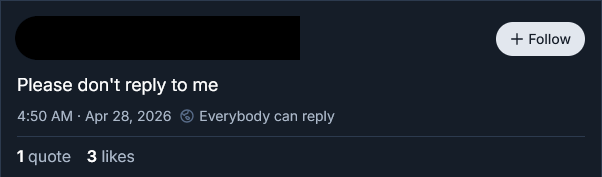
I run this website in part because I don't like it when other people try to argue at me about my work. I use Bluesky because it's quiet. I don't get any replies and I don't care; is that how a social network should be run?
Is that the social space that we all want to be in?
Earlier, I brought up Blacksky because I do genuinely think that that team is doing good work. If the AT Protocol does somehow take off and become the social media of the future, who am I to judge? It is better than Twitter. It is more accessible. There is, somehow, more interaction.
On the other hand, I'm starting to think that social media as it has existed for the past thirty years has started to make itself obsolete. It is more appealing to sign up for a forum or a Discord server — a space where you are automatically paired with people who share a similar interest — than to exist in the raw and open wound of every single human being with access to an email address.
The real "networks of the future" aren't going to work like this. Bluesky isn't even working like this. It's clinging to the social network of the past and trying to reach out towards the future. It's unsteady. It's going to fall. And when it does, when the ship finally sinks, we're all going to move on to something else.
And we'll keep doing it.